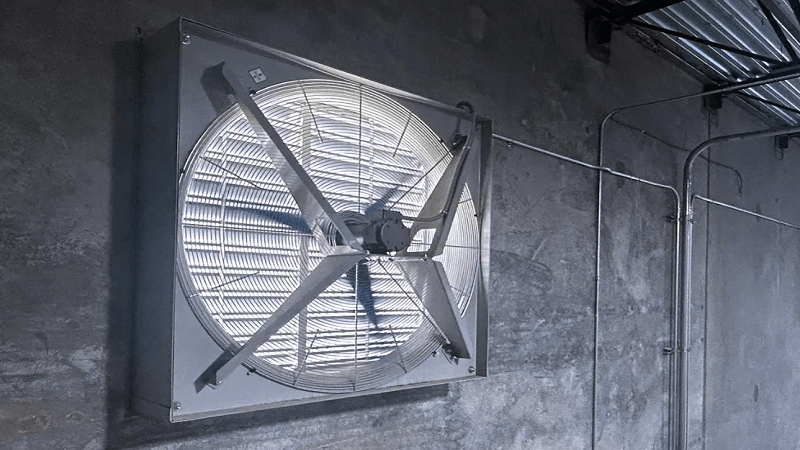
Proper ventilation is fundamental to maintaining a safe, productive, and durable industrial environment. Manufacturing facilities, warehouses, workshops, processing plants, and commercial buildings can accumulate heat, humidity, dust, fumes, vapors, and airborne contaminants when air is not exchanged effectively. An industrial exhaust fan helps remove unwanted air and replace it with cleaner air, but selecting the right fan requires more than choosing a model based on size or motor power. The fan must match the building, operating conditions, contaminants, airflow requirements, and ventilation objectives. A well-planned selection process improves air movement while avoiding unnecessary energy use, noise, and maintenance problems.
Start With the Required Airflow
The first consideration when selecting an exhaust fan is the volume of air that needs to be moved. Airflow is commonly expressed in cubic feet per minute (CFM), and the appropriate requirement depends on the size and purpose of the space. A large warehouse with relatively low contaminant production may have different ventilation needs from a compact production area where heat, smoke, or chemical vapors are generated continuously.
Air changes per hour can provide a useful starting point for general ventilation. However, industrial environments often require more specific calculations because contaminants may originate from particular machines or processes. Local exhaust ventilation, for example, is designed to capture contaminants near their source rather than relying entirely on whole-room air exchange.
When determining airflow, consider the room’s dimensions, occupancy, process equipment, heat generation, and contaminant sources. Oversizing a fan is not automatically better. Excessive airflow can increase energy consumption, create uncomfortable drafts, and interfere with controlled environmental conditions. Conversely, an undersized fan may run continuously without adequately removing contaminated or overheated air.
Evaluate Static Pressure and System Resistance
Airflow ratings alone do not tell the whole story. Industrial exhaust fans must overcome resistance created by ductwork, louvers, filters, dampers, bends, transitions, and other components. This resistance is expressed as static pressure. A fan capable of moving a specified volume of air under free-air conditions may deliver considerably less airflow once connected to a restrictive ventilation system.
This is where careful fan selection becomes especially important. Resources from the ventilation supplier can help illustrate why airflow and static pressure should be evaluated together rather than treated as separate specifications. A fan should be selected according to its operating point—the combination of airflow and pressure at which it will actually perform.
Duct design also affects performance. Long duct runs, sharp bends, undersized ducts, and unnecessary restrictions can increase pressure losses. Before choosing a fan, calculate or estimate the resistance of the complete system. Reviewing the fan curve is equally important because it shows how airflow changes as static pressure increases.
For demanding installations, comparing the exhaust fan configurations available through Industrial Fans Direct can help clarify which specifications influence performance. The objective should be to match the fan to the ventilation system rather than select equipment based solely on horsepower or advertised maximum airflow.
Choose the Right Fan Type for the Application
Different industrial fan designs perform differently, so the application should determine the fan type. Axial fans are commonly used when large volumes of air must be moved against relatively low pressure. They can be suitable for general building ventilation, warehouses, workshops, and other applications where straightforward air movement is required.
Centrifugal fans, by contrast, are generally better suited to systems with higher resistance. Their design allows them to maintain useful airflow against greater static pressure, making them common in ducted systems and applications involving filtration or contaminant capture.
The environment itself also matters. Facilities handling corrosive chemicals, high temperatures, combustible dust, or moisture may require specialized fan construction and motor arrangements. Materials should be compatible with the surrounding atmosphere, while electrical components must be appropriate for the hazardous conditions where applicable. For environments with combustible dust or flammable vapors, applicable safety standards and hazardous-location requirements should be evaluated by qualified professionals.
Noise is another practical consideration. A fan that provides sufficient airflow but produces excessive noise can negatively affect workers and the surrounding environment. Acoustic requirements should therefore be considered during system design rather than treated as an afterthought.
Consider Temperature, Contaminants, and Operating Conditions
Industrial exhaust applications vary significantly in the type of air being moved. Ordinary warm air is very different from air containing grease, abrasive dust, corrosive chemicals, or high concentrations of moisture. These conditions influence fan construction, materials, motor selection, and maintenance requirements.
Temperature is particularly important. Motors, bearings, seals, and other components have operating limits, and continuously moving high-temperature air can shorten equipment life if the fan is not designed for the application. Similarly, abrasive particles can wear fan blades and internal components over time.
The nature of the contaminants should also determine whether additional equipment is required. Exhausting contaminated air directly outdoors may not be appropriate if the air contains hazardous substances or pollutants regulated by environmental or occupational requirements. Depending on the process, filtration, scrubbing, or other treatment may be necessary before discharge.
A thorough assessment should consider:
- Air temperature and humidity
- Dust, fumes, vapors, or chemical contaminants
- Required airflow and static pressure
- Fan operating schedule and duty cycle
- Electrical supply and motor requirements
- Available installation space
- Noise and vibration limitations
- Maintenance and access requirements
These factors provide a more reliable basis for fan selection than relying on room size alone.
Plan Installation and Airflow Direction Carefully
Even a correctly specified fan can perform poorly if it is installed incorrectly. Exhaust fans need an effective path for contaminated or heated air to leave the building, along with an adequate source of replacement air. If makeup air is insufficient, the building can develop negative pressure, reducing fan performance and potentially causing doors to become difficult to open or drawing unconditioned air through unwanted gaps.
The location of the fan also matters. Exhaust should generally be positioned so that removed air does not re-enter through doors, windows, air intakes, or other openings. In process areas, the exhaust point should support the intended airflow pattern and avoid pushing contaminants through occupied workspaces.
Ducted systems should be designed to minimize unnecessary resistance. Properly sized ducts, smooth transitions, appropriately designed elbows, and accessible maintenance points can all contribute to more consistent performance. Vibration isolation may also be necessary where rotating equipment is installed near occupied areas or sensitive machinery.
Account for Energy Efficiency and Maintenance
An industrial exhaust fan may operate for thousands of hours over its service life, making energy consumption an important part of the selection decision. Motor efficiency, fan efficiency, operating point, control strategy, and system resistance all influence energy use.
Variable-speed drives can be beneficial in applications where ventilation demand changes during different operating periods. Rather than running continuously at full speed, the system can adjust airflow according to process requirements when the equipment and control system are designed for that approach.
Maintenance should be considered from the beginning as well. Fans require periodic inspection of bearings, belts where applicable, guards, electrical connections, blades, and mounting hardware. Dust accumulation can affect balance and performance, while worn components can increase vibration and operating costs. Equipment that is difficult to access may receive inadequate maintenance, so serviceability should be part of the design decision.
Make the Selection Based on the Complete System
Selecting an industrial exhaust fan is ultimately a system-design decision rather than a simple equipment purchase. The correct solution must deliver the required airflow at the expected static pressure while remaining compatible with the temperature, contaminants, operating schedule, electrical conditions, and installation environment.
Start with the ventilation objective, establish the required airflow, calculate system resistance, and then compare fan types and performance curves. From there, evaluate construction materials, motor characteristics, controls, noise, maintenance access, and applicable safety requirements. This method reduces the risk of selecting equipment that looks adequate on paper but fails to deliver the required performance after installation.
Final Analysis
Effective industrial ventilation depends on matching the fan to the conditions in which it will operate. Airflow, static pressure, fan design, contaminants, temperature, installation layout, energy consumption, and maintenance requirements all influence long-term performance. By evaluating these factors together, facility managers and engineers can develop ventilation systems that remove unwanted heat and contaminants efficiently while supporting safer and more consistent working conditions. A carefully selected exhaust fan is therefore not simply an air-moving device—it is an important component of the facility’s overall environmental and operational control strategy.