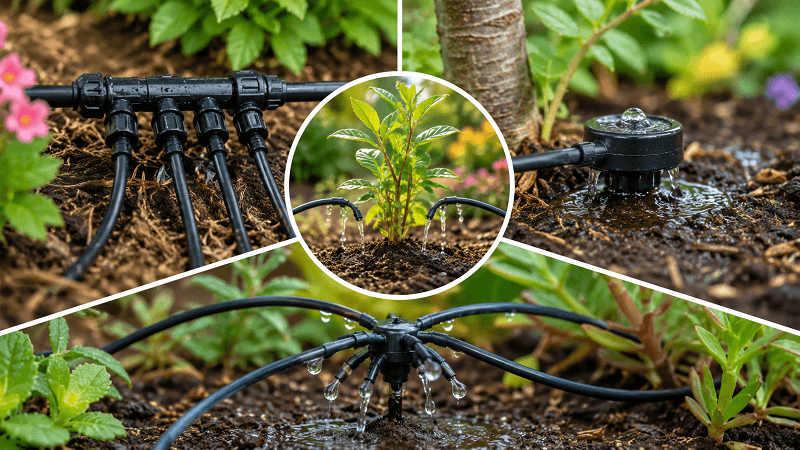
Multi-outlet drip emitters are useful when you need controlled watering from one supply point to several nearby plants. They are common in retrofit work, container groups, shrub beds, tree rings, raised beds, and planting areas where running a separate emitter from the mainline to every plant would look messy or take too much labor.
Used well, they simplify a system. Used poorly, they create a tangle of 1/4 inch tubing, uneven flow, buried connections, and service problems that show up six months later when one plant is thriving and the next one is dry.
This guide looks at when to use multi-outlet devices, how to choose between manifolds, bubblers, and multi-port emitters, and how NDS compares with four strong alternatives: Rain Bird, DIG, Hunter, and Netafim.
Why Multi-Outlet Emitters Are Often the Right Retrofit Tool
Many irrigation upgrades start with an existing spray riser. The site already has pipe, valves, and zone wiring, but the spray pattern no longer makes sense. Maybe the planting has changed. Maybe water is hitting pavement. Maybe the customer wants lower-volume irrigation without rebuilding the entire zone.
That is where multi-outlet emitters become useful.
A multi-outlet device lets you convert one riser into several small watering points. Instead of installing a new lateral line across the whole bed, you connect 1/4 inch tubing to several outlets and run each tube to a plant, pot, bubbler, micro-spray, or drip point. NDS describes its multioutlet emitters as devices that conveniently water a group of plants, and its product range includes drip emitters, bubblers, micro-sprays, tubing, fittings, stakes, regulators, valves, and related accessories.
In the field, that convenience is valuable. A contractor can turn a spray head location into a tidy drip distribution point. A property owner can water multiple shrubs from one accessible cap. A maintenance crew can inspect one hub instead of chasing emitters scattered through mulch.
Still, the product has to be selected carefully. Multi-outlet devices are not magic. They still need pressure control, filtration, reasonable tubing runs, and a clear plan for unused outlets.
Manifold, Bubbler, or Multi-Port Dripper?
The terminology can get confusing because manufacturers use these labels differently. What matters in practice is how the device controls flow and how it connects to the plants.
A manifold is usually a distribution hub. Some manifolds simply split water into several outlets and depend on downstream emitters or devices to control flow. Others include pressure regulation or flow control at the hub.
A multi-outlet bubbler usually delivers water from several outlets, often directly through 1/4 inch tubing, with higher flow than small drip emitters. Adjustable versions let each outlet be tuned up or down.
A multi-port dripper generally provides several pressure-compensating outlets from one body. These are often used for groups of plants that need uniform flow.
Here is the practical decision. If each plant needs its own known flow rate, choose a pressure-compensating multi-port emitter or a manifold feeding pressure-compensating emitters. If each plant needs adjustable watering, such as mixed shrubs or uneven container sizes, an adjustable bubbler can be useful. If the hub is only a distribution point, use it as a manifold and control flow at the end of each 1/4 inch tube.
Where These Devices Work Best
Multi-outlet products shine when plants are grouped close enough that short distribution tubes can reach them cleanly. They are especially useful around:
- shrub clusters
- tree wells
- rose beds
- raised planters
- patio containers
- foundation planting areas
- retrofit spray zones
- nursery or greenhouse pots
The key word is “nearby.” Long runs of 1/4 inch tubing create friction loss, clutter, damage risk, and hard-to-trace failures. If the plants are spread across a large area, build a proper dripline or point-source layout from a main distribution line instead.
When I review a proposed multi-outlet layout, I look for three things: short tubing runs, accessible service points, and flow rates that match the plants. If those are missing, I usually redesign before product selection.
Pressure Compensation Is the Feature to Look For First
A multi-outlet device can look organized while still watering unevenly. The first outlet may discharge more than the last outlet. A low plant may receive drainage after shutoff. A sloped zone may favor the downhill side. These are not theoretical problems. They are everyday service calls.
Pressure-compensating products help reduce that risk by keeping flow more consistent across a working pressure range. NDS Cuatro-Flo pressure-compensating bubblers convert a sprinkler riser into a multi-outlet low-flow drip emitter, with four barbed swivel outlets and color-coded flow rates of 2, 6, 10, and 20 GPH per outlet. NDS states that each outlet maintains a steady discharge rate even when water pressure varies, up to standard drip irrigation pressures of 50 PSI.
Hunter’s Multi-Port Emitters also use pressure compensation. Hunter describes them as six-port emitters designed to irrigate groups of plants from one source, with color-coded flow options and vinyl plugs for unused ports.
For commercial work, slopes, high-value plants, or any system that will be judged by uniform plant response, I usually favor pressure-compensating outlets. Adjustable flow has its place, but it requires a more disciplined installer and a more attentive maintenance crew.
Adjustable Flow Can Be Helpful, But It Needs Control
Adjustable multi-outlet bubblers are appealing because they let you fine-tune each outlet. That helps when one outlet serves a large shrub, another serves a small perennial, and another serves a container. NDS Hydro-Port adjustable flow bubblers are available with four or eight outlets, with each outlet adjustable up to 20 GPH.
That flexibility can be useful, but it also introduces risk. Someone can adjust a port without understanding the irrigation schedule. A high-flow outlet can flood a pot. An outlet can be closed by accident. If the site has inconsistent maintenance, fixed-flow or pressure-compensating options are often safer.
Adjustable flow works best when the system owner knows what each outlet is watering and can inspect it regularly. For public sites or commercial properties with rotating crews, I prefer products that limit guesswork.
Supplier Comparison: NDS, Rain Bird, DIG, Hunter, and Netafim
Each of these suppliers can support a strong multi-outlet design, but they are not interchangeable. Their strengths line up with different applications, sales channels, and maintenance expectations.
NDS
NDS is a practical supplier for residential, commercial, garden, and retrofit irrigation work. Its catalog of multi-outlet emitters for irrigation includes Cuatro-Flo pressure-compensating bubblers and Hydro-Port adjustable flow bubblers. Cuatro-Flo has four barbed swivel outlets and fixed, color-coded outlet flows. Hydro-Port is available in four-outlet and eight-outlet models, with individually adjustable discharge from 0 to 20 GPH per outlet.
The NDS advantage is not only the emitter body. It is the surrounding ecosystem. NDS sells dripline, tubing, fittings, emitters, bubblers, micro-sprays, misters, stakes, regulators, valves, and accessories, which helps contractors assemble a full low-volume system without piecing together too many brands.
Where NDS earns its place: retrofit risers, grouped shrubs, trees, garden areas, and contractor installations where the installer wants a complete parts family.
Be selective when: the project requires greenhouse-grade uniformity, fertigation accuracy, or very high production consistency across thousands of containers. In those cases, compare NDS with Netafim.
Rain Bird
Rain Bird is a familiar option for contractors and specifiers who already use its valves, controllers, dripline, and emission devices. Its 6-Outlet Drip Manifold connects 1/4 inch tubing to a standard 1/2 inch male pipe threaded riser and can feed emitters, bubblers, micro-sprays, or emitter tubing. Rain Bird describes the outlets as barbed connections that securely hold 1/4 inch tubing.
Rain Bird also offers the Xeri-Bird 8, an eight-port drip emission device, and identifies the EMT-6XERI manifold as a non-pressure-compensating transfer manifold. Its micro-bubblers add another option, with adjustable flow from 0 to 13 GPH and pressure-compensating operation.
Where Rain Bird is especially useful: professional retrofits where a manifold feeds downstream emitters or micro-devices, and the contractor values broad distribution and product familiarity.
Check before specifying: whether the selected Rain Bird device is acting only as a transfer manifold or is controlling flow itself. If it is only distributing water, you still need downstream emission devices or careful flow control.
DIG
DIG is a strong brand for accessible drip irrigation products, especially where retrofits, garden work, and small commercial installations are involved. DIG states that its pressure-compensating multi-outlet drip emitter manifolds are designed for first-time installations and for retrofitting existing sprinkler systems. Its professional drip emitter page also notes that DIG offers pressure-compensating multi-outlet manifolds for low-flow irrigation needs.
DIG’s documentation also describes 12-outlet manifold kits designed to convert an existing 1/2 inch sprinkler riser into a 12-outlet drip irrigation system. For higher-flow micro watering, DIG’s adjustable mini-bubbler delivers up to 31.5 GPH with coverage up to 3.3 feet at 30 PSI.
Where DIG performs well: homeowner and contractor retrofits, gardens, small planting beds, patio containers, and installations where a riser conversion kit simplifies the job.
Confirm carefully: the specific model’s flow behavior, whether it is pressure-compensating, how unused outlets are sealed, and what filtration is required. DIG sells several emitter families, so the correct choice depends on the exact product, not just the brand.
Hunter
Hunter’s Multi-Port Emitters are designed for irrigating plant groups from one source. The standard MPE product has six ports per emitter, pressure compensation, color coding that aligns with Hunter’s single-port emitters, and vinyl plugs for unused ports. Hunter also offers a gray Multi-Port Manifold that provides six ports of unrestricted flow.
Hunter’s micro irrigation literature adds useful technical context: its multi-port emitters are intended for multiple watering points, while the broader point-source product line lists self-flushing diaphragm technology, working pressure of 20 to 50 PSI, minimum filtration of 150 mesh, and a two-year warranty.
Where Hunter is a smart choice: residential and commercial systems already built around Hunter products, especially where pressure compensation and predictable flow are needed from a compact six-port body.
Review during design: whether you need the pressure-compensating MPE or the unrestricted-flow manifold. They serve different purposes, and substituting one for the other can change zone performance.
Netafim
Netafim belongs in the comparison when the application moves toward greenhouse, nursery, container production, or high-value plant material. Its Multi-Outlet Dripper Assemblies are positioned as labor-saving systems for potted plants and include pressure compensation plus a built-in check valve, a combination Netafim refers to as PCNL. Netafim states that the system helps every plant receive the same amount of water and fertilizer regardless of its position, with 94% watering uniformity on rolling or sloped ground.
Netafim also offers manifolds and adapters that connect to on-line drippers or dripline adapters and distribute water to multiple points through up to eight microtubes. That makes the product line relevant for production environments where labor savings and consistent fertigation delivery have direct financial impact.
Where Netafim leads: greenhouses, nurseries, container production, potted plants, and high-value growing operations where flow uniformity and check-valve performance are central to the irrigation strategy.
Consider alternatives when: the job is a simple residential riser conversion and the buyer wants common contractor counter availability more than production-level irrigation control.
Supplier Comparison Table
| Supplier | Strong application | Notable advantage | Specification caution |
| NDS | Grouped shrubs, trees, gardens, retrofit risers | Pressure-compensating Cuatro-Flo and adjustable Hydro-Port options | Choose fixed-flow or adjustable-flow based on maintenance discipline |
| Rain Bird | Contractor retrofits and professional site irrigation | Familiar manifold and bubbler ecosystem | Some manifolds distribute water but do not regulate each outlet |
| DIG | Garden retrofits and small commercial projects | Broad manifold and bubbler range, including 12-outlet kits | Verify exact flow control and pressure-compensation features |
| Hunter | Residential and commercial grouped plant watering | Six-port pressure-compensating MPEs with plug options | Do not confuse MPEs with unrestricted-flow manifolds |
| Netafim | Greenhouse, nursery, and container production | PCNL multi-outlet assemblies with high uniformity | May be more technical than needed for basic retrofit work |
Design Advice Before You Install
A tidy multi-outlet installation begins before the first tube is cut. Decide where the hub will be serviced, how far each 1/4 inch tube will run, and which outlet waters which plant. If the layout is not obvious later, label it or draw a simple as-built sketch.
Keep tubing runs short. Stake the discharge points. Cap unused outlets with the manufacturer’s supplied plugs or caps. Flush the supply line before connecting the device. Use a filter and pressure regulator that match the product family. Avoid burying a manifold where no one can inspect it.
One more practical note: do not overload a zone just because the manifold has unused ports. The valve, pipe, regulator, and filter still have capacity limits. DIG’s troubleshooting guidance, for example, points users to check clogged drippers, faulty pressure regulation, and excessive numbers of drippers or micro sprinklers when flow is uneven or missing at the end of a line.
When I Would Choose Each Type
- For a spray-to-drip conversion serving a handful of shrubs, I would look at NDS Hydro-Port, NDS Cuatro-Flo, Rain Bird manifolds, DIG manifolds, or Hunter MPEs depending on whether I need adjustable flow or fixed pressure-compensating outlets.
- For containers on a patio, I would favor products with visible outlets, easy adjustment, and service access. Adjustable bubblers can work well here, provided the user checks them occasionally.
- For greenhouse pots or nursery production, I would put Netafim near the top of the list because pressure compensation, check valves, and fertigation uniformity carry more operational value in that setting.
- For slopes, I would favor pressure-compensating devices and consider check-valve features where drainage after shutoff creates low-end saturation.
- For a mixed planting area where each plant has different water demand, adjustable bubblers can work, but only when maintenance is reliable. Otherwise, fixed-flow emitters with a clear plan are usually safer.
Final Recommendation
Multi-outlet drip emitters are best used as controlled distribution points, not as shortcuts for weak design. They work well when plants are grouped, tubing runs are short, pressure is managed, filtration is included, and the installer leaves the system serviceable.
For general residential and commercial irrigation, NDS is a viable solution because it offers both pressure-compensating and adjustable multi-outlet options, backed by a broad drip accessory system. Rain Bird is a strong contractor alternative, especially when the system already uses Rain Bird components. DIG is well suited to retrofits and garden-scale projects where manifold kits simplify installation. Hunter is a good choice when a six-port pressure-compensating emitter fits the layout. Netafim is the stronger candidate for greenhouse, nursery, and container production where uniform water and fertilizer delivery justify a more technical specification.
Choose the device around the site, not around the catalog photo. If the plants are close together, the hub is accessible, and the flow control matches the planting, a multi-outlet emitter can be one of the cleanest and most efficient ways to water several plants from one source.