For decades, small service businesses competed on reputation, location, price, and word of mouth. A homeowner needed a plumber, asked a neighbour for a recommendation, found a number, and made a call. An electrician with a good reputation could depend on repeat customers and referrals without thinking too much about what appeared on a search engine.
That behaviour has changed.
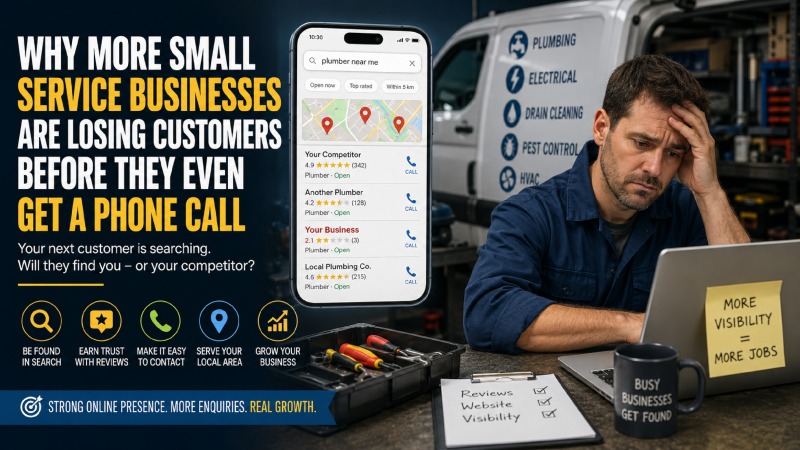
Today, a large part of the buying decision happens before a customer speaks to anyone. People search Google, scan Google Maps, compare ratings, read several reviews, check photographs, visit websites, and sometimes look at social media accounts. By the time they eventually call a local business, they may already have eliminated five or ten competitors.
For small service companies, this creates an unusual problem. They can lose a customer without ever knowing that customer existed.
The First Conversation Now Happens on a Screen
Imagine a homeowner discovers water beneath the kitchen sink. The first reaction may once have been to phone a familiar plumber. Now, the more common instinct is often to search something like “plumber near me” or “emergency plumber” on a smartphone.
Within seconds, the customer has options.
One company has hundreds of positive reviews. Another has a professional website and clear opening hours. A third appears prominently on Google Maps and shows photographs of recent work. Another business has only three reviews, an outdated website, and a telephone number that is difficult to find.
The customer is already forming opinions.
None of those businesses has spoken to the person yet, but some have moved closer to winning the job while others have effectively disappeared from consideration.
This is why online visibility has become more than a marketing issue. For many local businesses, it now functions as part of the sales process.
A company’s Google Business Profile, website, reviews, service descriptions, photographs, and search rankings collectively create a digital first impression. Customers often use these signals to decide whether a business looks trustworthy enough to contact.
Word of Mouth Has Not Disappeared. It Has Changed
Recommendations still matter enormously, particularly for trades where customers allow workers into their homes or depend on them to solve expensive problems.
What has changed is what happens after the recommendation.
Someone might tell a friend, “Call this electrician. They did great work for us.” Instead of immediately calling, the friend may search the electrician’s business name first.
They want reassurance.
Are the reviews good? Is the company still operating? Does it serve their neighbourhood? Does the website look legitimate? Are there recent photographs? Are the opening hours clear?
In other words, traditional word of mouth and digital reputation now overlap.
A personal recommendation may create interest, but an uncertain online presence can weaken that recommendation before the business ever gets a chance to respond.
The opposite is also true. Strong search visibility can introduce a customer to a company they have never heard of and quickly give that business enough credibility to earn an enquiry.
Local Search Has Become a Competitive Marketplace
This shift matters especially for businesses that depend on customers within a defined service area.
Plumbers, electricians, roofers, cleaners, landscapers, HVAC companies, locksmiths, painters, pest control businesses, appliance repair technicians, and similar providers rarely need visibility across an entire country. They need to be visible at the exact moment someone nearby has a problem.
That makes local search unusually valuable.
Consider pest control. Someone who discovers termites, rodents, ants, or another problem is unlikely to spend weeks researching providers. They typically want a trusted local company that can explain the problem and offer help quickly.
For pest control companies, appearing prominently for relevant local searches can therefore have a direct relationship with enquiries. Agencies offering specialised services such as Dagmar’s pest control SEO services reflect how niche this part of digital marketing has become. Instead of treating every business the same, local SEO increasingly focuses on the search behaviour, competition, terminology, and service areas of a particular industry.
The same principle applies across other trades.
An electrician may need visibility for searches involving panel upgrades, rewiring, emergency repairs, or EV charger installations. A plumber may compete for drain cleaning, water heater repair, leaking pipes, and emergency call-outs. A cleaning company may target residential cleaning, office cleaning, move-out services, or specific neighbourhoods.
Each service creates another opportunity to appear when someone is actively looking for help.
Reviews Are Becoming a Form of Digital Trust
Search rankings may determine which companies customers notice, but reviews often influence which businesses they actually contact.
People naturally look for shortcuts when making decisions. Reviews provide one.
A customer cannot personally inspect every plumbing company or interview five pest control technicians before requesting an estimate. Instead, they look for evidence from previous customers.
A consistent stream of recent reviews suggests that the company is active and regularly serving clients. Detailed comments can answer questions that a basic advertisement cannot. Customers may learn whether technicians arrived on time, communicated clearly, respected the property, solved the problem, or handled an unexpected complication professionally.
Negative reviews matter too, but not always in the way business owners fear.
Almost every established company eventually receives criticism. Customers may pay more attention to how the business responds. A calm, useful response can demonstrate professionalism, while an aggressive or dismissive reply can create a larger problem than the original complaint.
For small businesses, reputation management is therefore no longer something that happens only when something goes wrong. It has become an ongoing part of customer acquisition.
A Weak Website Can Quietly Cost a Business Enquiries
Search visibility gets a potential customer through the digital front door. The website then has to make the next step easy.
This sounds simple, yet many service business websites still create unnecessary friction.
Telephone numbers are difficult to locate. Contact forms ask too many questions. Service areas are unclear. Pages load slowly on mobile devices. Important services are buried inside complicated menus. Some websites provide almost no explanation of what the company actually does.
Customers rarely announce that these problems caused them to leave. They simply press the back button and choose another provider.
That makes website problems particularly dangerous. A business owner may believe marketing is working because traffic is increasing, while potential customers are quietly abandoning the site before making contact.
The most useful local service websites tend to answer practical questions quickly: What does this company do? Does it serve my area? Can I trust it? How do I contact someone?
Everything else supports those answers.
Convenience Is Part of the Competition Now
Small businesses often think they are competing primarily on price and quality. Increasingly, they are also competing on convenience.
Can someone call directly from a mobile search result?
Can they request an estimate without spending ten minutes completing a form?
Can they see business hours immediately?
Can they understand whether emergency appointments are available?
Can they find directions?
Can they see photographs of completed work?
When several companies appear equally capable, these small conveniences can become deciding factors.
This does not mean every local business needs complicated technology. In many cases, the advantage comes from making basic information easier to find.
A complete Google Business Profile, accurate opening hours, current telephone number, useful service pages, clear location information, and recent reviews may accomplish more than an elaborate digital campaign built on a weak foundation.
Offline Excellence Still Matters, but It Needs Online Proof
None of this makes craftsmanship less important.
A plumber still needs to fix the pipe. An electrician still needs to work safely. A cleaner still needs to deliver consistent results. A pest control professional still needs to solve the infestation.
Digital visibility cannot compensate indefinitely for poor service.
What has changed is that excellent service alone may not guarantee that enough new customers discover the business.
A highly skilled contractor with almost no online presence can now lose work to a slightly less established competitor that appears prominently in search results and gives customers more confidence online.
This is one of the uncomfortable realities of modern entrepreneurship: being good at the work and being easy to discover have become separate business capabilities.
Successful small companies increasingly need both.
Local Search Matters Beyond the Traditional Trades
The same behaviour extends into hospitality, tourism, and events, where customers often research locations extensively before contacting anyone.
Someone organising an event, for example, may begin with broad geographic searches and compare photographs, reviews, capacity, surroundings, and accessibility before requesting a tour. A property positioned online as a venue can reach clients precisely when they are narrowing their options by location.
That decision process is remarkably similar to what happens with home services. Search creates the shortlist before direct communication begins.
Businesses serving highly specific local markets face the same challenge. A customer searching for an event venue may review multiple properties online before any venue receives an enquiry. The organizations that communicate their location, offering, reputation, and value most clearly have a better chance of making that shortlist.
The Customer You Never Heard From Still Matters
Perhaps the biggest change for small service businesses is psychological.
Owners naturally pay attention to enquiries they receive. They know when a customer calls, requests an estimate, complains about pricing, or chooses a competitor.
What they cannot easily see are the customers who searched, compared, rejected the business, and moved on without making contact.
Those invisible losses can add up.
A company might have excellent technicians, competitive prices, loyal customers, and strong local recognition yet still struggle to grow because its digital presence does not reflect the quality of the actual business.
For modern SMEs, online visibility is no longer separate from the customer experience. Increasingly, it is where that experience begins.
The phone call is simply the next step.
And for businesses that fail to appear credible, relevant, and easy to find online, that phone call may never come.